Ark Aid Street Mission is sounding the alarm a day after a federal homelessness program and city hall’s cold weather response ended.
Executive Director Sarah Campbell says the financial shortfall will exceed $1 million for the frontline agency, forcing several difficult but necessary service cuts for homeless Londoners.
It represents approximately one-third of their operational funding, and means essential services like meals, showers, clothing, washroom access, assessments, referrals, and system navigation will now rely entirely on donor support.
A total of 50 overnight spaces this winter (across three locations) will immediately cease.
The Ark had operated London’s only seven day-a-week open door emergency service outside regular business hours.
Services at 696 Dundas St. will be reduced from between 20 and 24 hours a day — to just four hours.
“We’re currently stepping everything down, starting with the night beds for winter. We will then reduce our daytime hours and by the end of the month, we’ll have just four hours each day,” Campbell explained.
Those remaining hours will be around dinner time.
“We have anywhere between 50 to 70 people through the doors at any one time, and on an average weekend we’re seeing 400 unique individuals come through our space because on Saturdays, Sundays and holidays there are no other open doors,” Campbell added.
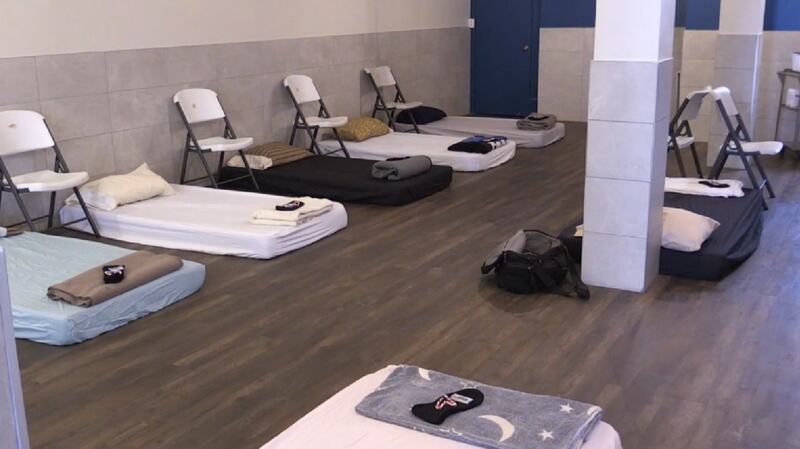
Shelter beds inside Ark Aid Street Mission at 696 Dundas St. in London, Ont. (File)
Twelve referral organizations had been utilizing The Ark as a drop-off location for homeless individuals, including London police and local hospitals.
Campbell is disappointed that no other government funding was made available before the previous federal program expired March 31.
“If we have zero government dollars, how do we make sure that we show up for the people who need us, when they need us most?” she asked rhetorically.
Among the other services lost or significantly reduced:
24/7 assessment and stabilization
Encampment meal service
Basic needs access reduced to five days/week
Diversion and pathway-to-home supports
“These are essential basic needs, but they’re also life saving activities,” Campbell explained. “We don’t allow any drug use on site, but we do have overdoses around our building regularly. In fact, we’ve responded to 29 overdoses just since January, so being present here is critical.”
Ark Aid Street Mission is issuing an urgent plea to donors and all levels of government.
“We would like the funding gap filled by the municipal government because that’s the [level of government] we can go to directly, but it’s not their responsibility alone,” Campbell told CTV News. “It was federal funding that had come to the municipality [that ended], so we’re advocating to all levels of government.”
Campbell worries that fewer services, resources and indoor spaces will lead to more suffering on the streets of London.
“I don’t think there’s a person in London who doesn’t know that this is a catastrophe,” she said.
The beds inside The Ark’s Cronyn Warner Shelter are not affected by the funding shortfall, but its funding is scheduled to expire in one year.
Life is a collection of chapters, and some of them are undeniably painful to read. There is a popular sentiment that offers profound hope: “Don’t give up because of one bad chapter in your life. Keep going. Your story doesn’t end here.” This wisdom acknowledges that struggle is a part of the narrative, but it insists that it is not the final page. It is a call for resilience, a reminder that identity isn’t fixed by moments of failure or despair.
However, if we apply this metaphor to the crisis of homelessness and addiction on our streets, we must ask ourselves: Are we helping people turn the page, or are we simply buying them a new bookmark while they remain stuck in the same chapter?
The current approach to homelessness is often too passive, too willing to enable stagnation. It can be patronizing to assume that someone in the throes of addiction or living on the streets doesn’t need a hard response. By removing all expectations—by offering housing without requiring sobriety or a commitment to rehabilitation—we risk telling people that they aren’t capable of more . We accept their bad chapter as the whole book.
We need a shift from a handout to a hand up. This means coupling compassion with accountability. It means recognizing that allowing someone to continue using drugs without intervention is not kindness; it is a slow form of surrender . A truly compassionate response says, “Your story doesn’t end in addiction, and it doesn’t end on this street corner.”
Programs that are beginning to see success are those that provide shelter and support, but also demand recovery and work . They enforce rules, ban public camping, and use the leverage of the law to nudge individuals toward treatment. This isn’t about punishment; it’s about instilling the self-worth that comes from meeting expectations .
If we want to help people write a better chapter, we must stop editing around the margins of their misery. We must provide the structure and the hard line in the sand that says giving up is not an option. Because their story—and ours as a community—doesn’t have to end there.
Housing First is an established concept in Finland since more than 15 years thanks to the Y-Foundation as a pioneer. The Y-Foundation was also one of the founding members of the Housing First Europe Hub.
In 2016 the Finish Y-Foundation together with FEANTSA established the Housing First Europe Hub. The Y-Foundation has been a key player in establishing Housing First as the main response to homelessness in Finland. Since 2007 national policies shifted towards reducing long-term homelessness through Housing First programmes.
As a result, in Finland, the utilisation of emergency and temporary accommodations, such as shelters, hostels, and temporary supported housing, has significantly declined. The number of homeless individuals residing in hostels or boarding houses decreased by 76% from 2008 to 2017. This reduction is attributed to the widespread adoption of prevention strategies, the replacement of outdated models of communal supported housing with Housing First and housing-led approaches, which largely replaced emergency shelters.
ARA, the Housing Finance and Development Centre, has also been involved in the implementation of Housing First in Finland since the start through subsidising new and renovated homes as well as giving housing advice to municipalities.
As a result, Finland is one of the only European countries that registers decreasing homelessness numbers. The country’s goal is to end homelessness in Finland all together.
Finland has managed to reduce homelessness in recent years, but homelessness as a phenomenon is still alive and well. The homelessness situation often escalates in the context of social and economic crises.
Poor people in Canada pay for funerals through provincial social assistance programs (like BC’s Ministry of Social Development or Ontario Works), the federal Canada Pension Plan (CPP) Death Benefit.
Many today are choosing simpler, lower-cost options like direct cremation, with funeral homes often guiding families through these limited financial resources. Government aid covers basic services, but often falls short of average funeral costs, requiring families to supplement or choose minimal arrangements.
Government Financial Assistance Provincial Programs: Most provinces have programs, often through social development or welfare ministries, to help with funeral costs if the deceased’s estate and family can’t pay.
British Columbia: The Ministry of Social Development and Poverty Reduction provides assistance, covering basic services, burial/cremation, and interment, working directly with funeral homes.
Ontario: Ontario Works helps cover basic funeral expenses for those in need, with a process involving your local office.
FederalProgram: Canada Pension Plan (CPP) Death Benefit: A one-time payment of $2,500 (a flat rate) is available if the deceased contributed to CPP for a minimum number of years, helping families with costs.
How the Process Works Contact the Ministry: After a death, the legal representative (executor) contacts the provincial ministry (e.g., Social Development) to see if the estate qualifies for assistance.
Work with Funeral Homes: Funeral directors are familiar with these programs and guide families to choose services within the available budget.
Ministry Pays the Funeral Home: If approved, the ministry pays the funeral home directly for approved services, which may cover cremation or burial and other basic costs.
Cost-Saving Options Direct Cremation: This is often the most affordable option, as it avoids embalming, viewing, and elaborate ceremonies. Simplified Services: Choosing basic services (no casket upgrades, flowers, or extensive visitations) keeps costs down.
Challenges Funding Gaps: Government funding often doesn’t cover the full average cost of a funeral, leaving a significant gap for families to fill. Limited Choices: Financial constraints restrict choices, making it hard to provide the send-off families desire.
Peace to All and Best Wishes to All in the New Year of Life and it’s passing encounters.
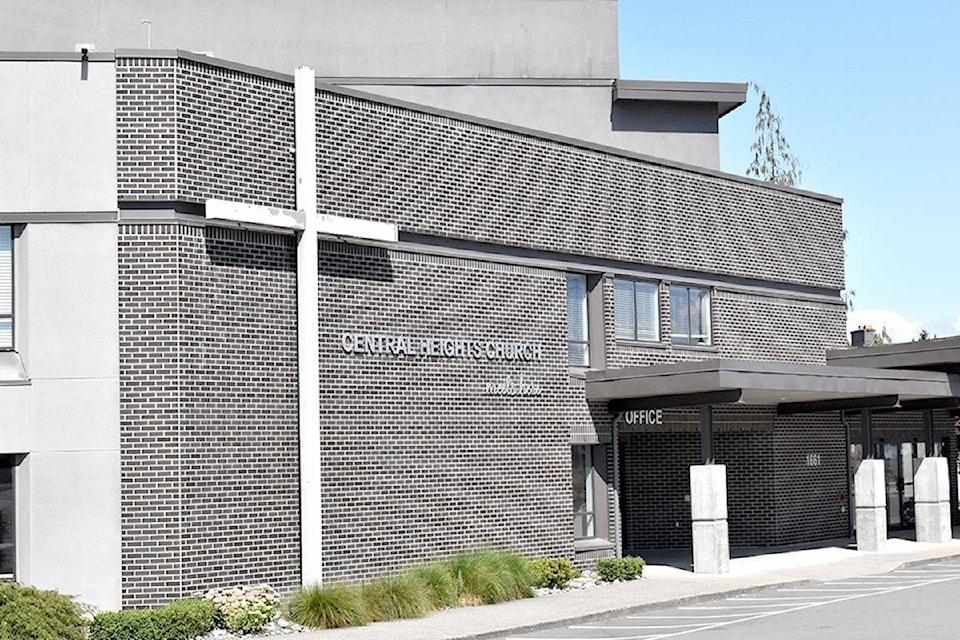
Central Heights Church in Abbotsford is planning a 30-bed emergency shelter for older adults. Ben Lypka/Abbotsford News file
Listen to this article by accessing the above player.
A 30-bed emergency shelter for older adults is being planned at Central Heights Church in Abbotsford.
The plan came before city council on Tuesday afternoon (Feb. 25), when a temporary-use permit and housing agreement were approved.
A staff report to council states that 30 individual “sleeping units” will be provided in an existing building on the church property at 1661 McCallum Rd.
That area at the north end of the building has been operating by Sparrow Community Services Society as a severe weather shelter for older adults.
A letter to the city from BC Housing in September 2024 states that in order to accommodate the emergency shelter, the building will be renovated to include sufficient washroom and shower facilities, accessible entry and operator spaces.
The space is expected to be completed this winter.
The Central Heights Church Shelter will continue to be run by Sparrow – which serves older adults (50+) who are at risk of homelessness – under an agreement with BC Housing.
Support services will be provided 24/7 under the Homelessness Encampment Action Response Temporary Housing (HEARTH) and Homelessness Encampment Action Response Team (HEART) programs.
The staff report to council says a temporary-use permit was required to accommodate the proposed use as it abuts an existing residential use.
The permit will be valid for three years, with the opportunity to request one three-year extension.
The housing agreement includes that the operators must form a good neighbour committee with monthly meetings for the first four months and then on an as-needed basis.
The operators must also provide support services – directly or through referrals – such as life-skills training, counselling and substance-use services.
They must also at least have two staff on site 24/7, and ensure that guests “do not disturb the peace, quiet and enjoyment of the neighbourhood.”
The project has drawn support from Fraser Health and the Abbotsford Police Department, which states that the current services offered at the site have required fewer police resources than comparable facilities.
The city says there are currently 40 encampments and more than 400 unhoused individuals across Abbotsford.
They may be small and swift, but if you notice this tiny silver creature scurrying around your home, you could be facing a significant and costly issue. Experts are advising anyone who spots a silverfish in their property to promptly check for dampness.
These shiny, teardrop-shaped insects thrive in moist conditions and are particularly fond of areas with water.
If you see one darting into or out of your skirting boards or crevices around window sills, it’s likely a sign of damp and moisture within your property. If not addressed, dampness can lead to a host of problems, including cracked bricks, rotting joists, decaying plaster, and spreading mould spores. In extreme cases, it can even compromise the structural integrity of the property and impact air quality.
Dampness can result from various factors, such as leaky drainpipes, condensation, ageing damp proofing, or inadequate ventilation, especially in bathrooms or kitchens where water vapour tends to linger. Identifying the cause can be tricky, but the presence of silverfish indoors usually signals that there’s dampness requiring attention.
Silverfish can be a sign of huge issues -Credit:Getty
The sooner signs of dampness are detected, the easier it will be to eradicate the bugs. It recommends looking for indications on walls like wet or damp patches, peeling wallpaper, and flaking plaster.
Other telltale signs include damp and musty smells, rotting wood, and the emergence of mould and mildew on walls, floors, or ceilings.
Among the proposed remedies are utilising a dehumidifier, maintaining good ventilation in your home, inspecting your gutters for leaks, applying damp-proof paint to your walls and, if necessary, engaging a professional to address areas impacted by rising dampness.
A slumlord is a derogatory term used to describe a landlord who knowingly maintains rental properties in poor or unsafe conditions, often while charging high rents. Slumlords typically neglect necessary repairs, ignore health and safety codes, and exploit tenants, often those in low-income or vulnerable situations who have limited housing options.
Characteristics of a Slumlord:
Poor Property Maintenance: Failing to address issues like leaky roofs, broken heating systems, mold, pest infestations, or structural problems.
Health and Safety Violations: Ignoring building codes, fire safety regulations, or sanitation standards.
Exploitation of Tenants: Charging high rents for substandard housing, often targeting tenants who lack the resources or knowledge to advocate for themselves.
Lack of Responsiveness: Ignoring tenant complaints or requests for repairs.
Illegal Practices: Engaging in unethical or illegal activities, such as wrongful evictions, rent gouging, or refusing to return security deposits.
The Shifting Sands of the Hourglass of World States, is there a Fourth World?
Legal Context in Canada and the US:
Both Canada and the US have laws and regulations to protect tenants from slumlords, but enforcement varies by region.
Canada: Provincial and territorial laws govern rental housing. Tenants can file complaints with local housing authorities or tenant boards if landlords fail to meet their obligations. For example, in Ontario, the Residential Tenancies Act outlines landlord responsibilities, and tenants can seek recourse through the Landlord and Tenant Board.
US: Housing regulations are enforced at the state and local levels. Tenants can report violations to local housing authorities or take legal action. Many cities have tenant rights organizations that assist renters in dealing with slumlords.
Tenant Rights:
Tenants in both countries have the right to:
Live in a safe and habitable environment.
Request necessary repairs.
Withhold rent or take legal action if the landlord fails to address serious issues.
Be free from retaliation for reporting violations.
Addressing Slumlord Practices:
Document Issues: Tenants should keep records of complaints, repairs, and communication with the landlord.
Report Violations: Contact local housing authorities or tenant advocacy groups.
Legal Action: In severe cases, tenants may sue for damages or force the landlord to make repairs.
Slumlords contribute to the broader issue of housing inequality and the lack of affordable, safe housing in many urban areas. Combating their practices requires stronger enforcement of housing laws and increased support for tenants.
Dealing with a slumlord can be incredibly frustrating and stressful, but there are steps you can take to protect your rights and improve your living situation. Here’s a guide to help you navigate the situation:
1. Know Your Rights
Familiarize yourself with local tenant laws and housing codes. These vary by location but generally guarantee your right to a safe and habitable living environment.
Common landlord responsibilities include providing:
Working utilities (heat, water, electricity).
Proper sanitation and waste disposal.
Structural integrity (no leaks, mold, or pest infestations).
Safe and secure locks on doors and windows.
If your landlord is failing to meet these standards, they may be violating the law.
2. Document Everything
Keep a detailed record of all issues, including:
Photos and videos of unsafe or unsanitary conditions.
Written notes about when problems started and how they’ve been ignored.
Copies of all communication with your landlord (emails, texts, letters, etc.).
This documentation will be critical if you need to take legal action or report the landlord.
3. Communicate with Your Landlord
Notify your landlord in writing about the issues and request repairs. Be specific, polite, and keep a copy of the letter or email.
If they don’t respond or refuse to make repairs, send a follow-up notice and mention your legal rights.
4. Report Code Violations
Contact your local housing authority, health department, or building code enforcement agency to report unsafe or unsanitary conditions.
An inspector may visit your property and issue a violation notice to the landlord, forcing them to make repairs.
Pittsburgh, Pennsylvania, USA – Some abandoned townhouses standing in Uptown district
5. Withhold Rent or Repair and Deduct
In some areas, tenants are allowed to withhold rent or pay for repairs themselves and deduct the cost from rent. However, this can be risky, so:
Check your local laws to ensure this is allowed.
Notify your landlord in writing before taking action.
Keep receipts and documentation for all repairs.
6. Join or Organize with Other Tenants
If other tenants are experiencing similar issues, consider organizing as a group. Landlords are more likely to respond to collective action.
You can also reach out to local tenant unions or advocacy groups for support.
7. Seek Legal Help
If your landlord continues to neglect their responsibilities, consult a tenant attorney or legal aid organization.
You may be able to:
Sue for damages or compensation.
Break your lease without penalty.
Force the landlord to make repairs through a court order.
8. Consider Moving
If the situation doesn’t improve and your health or safety is at risk, it may be best to find a new place to live.
Before moving, ensure you’re not violating your lease and that you’ve followed proper legal procedures to protect yourself from retaliation or eviction.
9. Report to Local Media
If the situation is severe and widespread, contacting local news outlets can bring attention to the issue and pressure the landlord to act.
10. Stay Safe
If you feel threatened or unsafe due to your landlord’s actions, contact local law enforcement or a tenant advocacy group immediately.
Resources to Help You:
Local Housing Authority: For reporting code violations or unsafe conditions.
Legal Aid Organizations: For free or low-cost legal advice.
Tenant Unions: For advocacy and support in organizing with other tenants.
State or Local Tenant Rights Websites: For information on your specific rights.
By taking these steps, you can hold your landlord accountable and work toward a safer, healthier living environment.